Selling Is an Art, Not a Formula

If selling were a science with one correct answer, every business would be successful.
We could simply follow the formula.

Find the right product.
Set the right price.
Choose the right platform.
Create the right advertisement.
And wait for the sales to arrive.
But business does not work that way.
Customers are not formulas.
Markets are not static.
And what worked yesterday may not work tomorrow.
Selling is an art.
There is no universal formula
Ask ten successful entrepreneurs how they built their businesses and you may receive ten completely different answers.
One might say that price was the most important factor.
Another might say that customer service made the difference.
Someone else might say that branding was essential.
Another might say that relationships were the key.
And they could all be right.
Success is not necessarily about discovering the answer.
It is about discovering your answer.
Every business has different customers, different competitors, different products and different challenges.
Finding the right combination takes time.
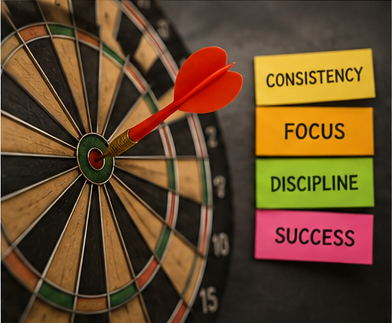
Experiment, learn and adapt
Successful sellers are not necessarily people who get everything right.
Often, they are people who are willing to discover what they are getting wrong.
Try something.
Measure the result.
Learn from it.
Change it.
Try again.
This process can be frustrating.
Sometimes an idea that seemed brilliant produces almost nothing.
Then another idea that seemed insignificant suddenly produces excellent results.
That is business.
And this is why perseverance matters.
You cannot discover a successful strategy if you give up every time something doesn't work.
Consistency creates credibility
There is another quality that is often underestimated:
Consistency.
A customer may not remember every interaction they have with your business.
But they remember how your business made them feel.
Was the information accurate?
Did you respond quickly?
Did you keep your promise?
Did you solve the problem?
Did you take responsibility when something went wrong?
Did you make an effort?
Each individual experience may seem small.
Together, however, they create something much bigger:
Reputation.
And reputation takes time to build.
Work on yourself
Perhaps one of the most important investments a salesperson can make is not in advertising, technology or inventory.
It is in themselves.
Learn more.
Understand your industry.
Understand your customers.
Understand your competitors.
Learn how to communicate better.
Become better at solving problems.
Learn to recognize opportunities.
Develop your knowledge.
The better you become, the more valuable the solutions you can offer.
And when customers recognize that difference, something interesting happens.
You stop competing only on price.
You start competing on value.
Go beyond expectations
There is something powerful about exceeding expectations.
When a salesperson takes the time to find an unusual answer, investigate a difficult request or solve a problem that technically isn't their responsibility, they are doing more than completing a transaction.
They are demonstrating commitment.
They are showing the customer:
"I care about getting this right."
Technology can be copied.
Prices can be copied.
Products can be copied.
But genuine commitment is much harder to copy.
Keep refining
Even when you find something that works, don't assume you have finished.
Markets evolve.
Customers change.
Competitors improve.
Technology develops.
Consumer expectations rise.
The strategy that worked perfectly last year may not be enough next year.

So perhaps the real skill isn't finding the perfect strategy.
Perhaps it is developing the discipline to keep improving the strategy.
Selling is not a destination.
It is a continuous process of observation, experimentation, learning and refinement.
There is no magic formula.
There is no single secret.
There is only the willingness to keep searching for what works—and the perseverance to keep improving it.
Because selling is not simply about convincing someone to buy.
It is about becoming someone worth buying from.
Take care!
Prof. Carl Boniface
Vocabulary Builder
1. Formula
A method or set of steps used to achieve a particular result.
Example: There is no simple formula for becoming successful.
2. Perseverance
The ability to continue doing something despite difficulties or failure.
Example: Learning a language requires patience and perseverance.
3. Adapt
To change something in order to deal with a new situation.
Example: Businesses must adapt to changing customer expectations.
4. Consistency
The quality of doing something in the same reliable way over time.
Example: Consistency is essential when building a strong reputation.
5. Credibility
The quality of being trusted and believed.
Example: His experience gives him credibility with customers.
6. Reputation
The general opinion that people have about a person or company.
Example: A company's reputation can take years to build.
7. Commitment
A strong willingness to give your time, energy or attention to something.
Example: Her commitment to customer service is impressive.
8. Refine
To improve something by making small changes.
Example: The company continues to refine its sales strategy.
Vocabulary Practice
Complete the sentences using the vocabulary from the list above.
There is no magic __________ for becoming a successful entrepreneur.
Learning from failure requires considerable __________.
Companies need to __________ when customer expectations change.
__________ is important because customers want to know what they can expect from a business.
His years of experience give him strong __________ in the industry.
A company's __________ can be destroyed by one serious mistake.
Her __________ to solving customer problems is clear.
We need to __________ our strategy rather than completely replace it.
Discussion
Do you believe there is a formula for business success?
How important is perseverance in your professional life?
Which is more difficult: attracting a new customer or keeping an existing one?
Can a company recover from a bad reputation? How?
What does "going the extra mile" mean to you?
How important is personal development for someone who works in sales?
Have you ever changed your strategy because something wasn't working?
What is one professional skill you would like to refine?
Answers
Formula
Perseverance
Adapt
Consistency
Credibility
Reputation
Commitment
Refine



Comentários