The New BMW iX3 2026: BMW’s Electric Revolution Has Arrived — and It Goes Far Beyond Range


BMW has opened a new chapter in automotive history with the launch of the new BMW iX3. Far more than just another premium electric SUV, the model introduces the revolutionary “Neue Klasse” platform — a completely redesigned architecture set to redefine performance, efficiency, and automotive technology.

With an impressive 469 hp, a driving range capable of exceeding 800 km (WLTP), and ultra-fast charging capability, the new iX3 is not simply an evolution. It represents a technological breakthrough.
But what exactly makes this BMW so revolutionary?
A Completely New Battery: More Efficient, Lighter, and Smarter
BMW has abandoned the older prismatic battery cells used in previous generations and adopted sixth-generation cylindrical lithium-ion cells (Gen6) measuring 46 mm in diameter.
The practical benefits are enormous:
20% to 30% higher energy density;
greater driving range;
lower overall weight;
improved structural rigidity;
reduced heat generation.
The approximately 108.7 kWh battery pack is now an integrated structural component of the vehicle. Instead of merely sitting beneath the car, the battery actively contributes to chassis rigidity, improving stability and driving dynamics.
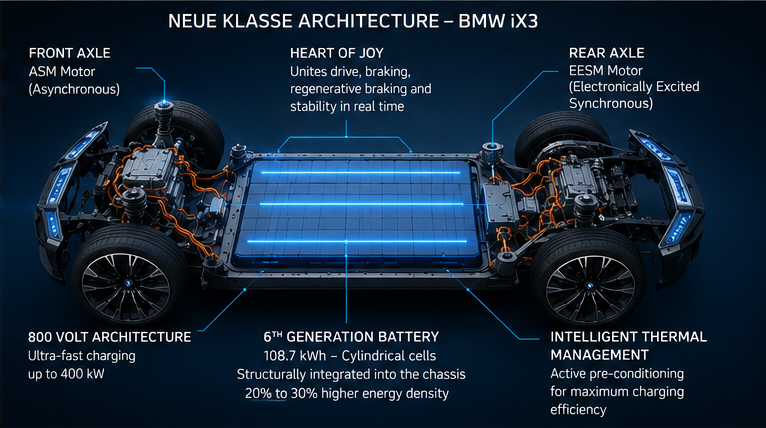
This also allowed BMW to maintain a completely flat floor, increasing interior space and passenger comfort — a major advantage in the premium SUV segment.
800-Volt Architecture: Extremely Fast Charging
The new iX3 uses an 800-volt electrical system, technology normally found in top-tier high-performance EVs.
In practical terms, this enables charging speeds of up to 400 kW.
According to BMW, the SUV can recover more than 350 km (over 200 miles) of range in just 10 minutes when connected to compatible ultra-fast chargers.
The new architecture also reduces heat buildup and decreases overall wiring weight throughout the vehicle.
Another highly sophisticated feature is intelligent thermal management: when a charging station is entered into the navigation system, the vehicle automatically preconditions the battery temperature before arrival, ensuring maximum charging performance immediately upon connection.
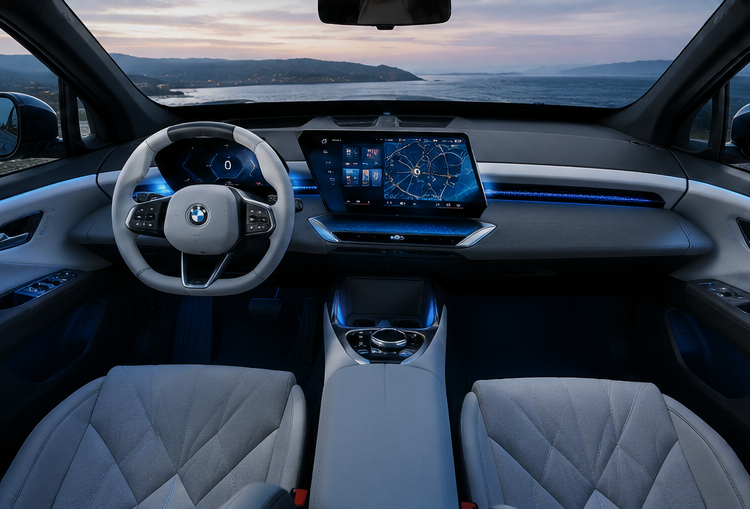
“Heart of Joy”: The New iX3’s Central Brain
BMW has also completely reinvented the vehicle’s electronics.
Instead of dozens of independent control modules scattered throughout the car, the new iX3 relies on four powerful centralized computing units responsible for managing virtually everything:
traction;
stability;
regenerative braking;
suspension dynamics;
vehicle control systems;
driver assistance technologies.
The system, known as “Heart of Joy,” integrates the electric drivetrain, regenerative braking, and stability systems into one intelligent control unit.
The result is exceptionally smooth, immediate, and highly responsive driving behavior.
BMW also managed to eliminate approximately 600 meters of wiring, significantly reducing total vehicle weight.
Rare-Earth-Free Motors: Sustainability Taken Seriously
Another impressive aspect of the new iX3 is BMW’s use of electric motors that do not require rare-earth metals.
BMW utilizes Electrically Excited Synchronous Motors (EESM) on the rear axle and Asynchronous Motors (ASM) on the front axle.
This reduces dependence on expensive and environmentally problematic materials while still delivering exceptional efficiency and performance.
The xDrive all-wheel-drive system delivers instant torque, and the 469 hp output makes the SUV remarkably fast for its size.

And What About Brazil? Suspension Concerns Remain
Despite all this revolutionary technology, one reality remains unchanged: Brazilian roads continue to be extremely demanding for premium vehicles.
Potholes, uneven pavement, aggressive speed bumps, and poor road conditions still require special attention from owners.
In the case of the new iX3, this becomes even more important.
Because the battery pack is structurally integrated into the chassis, severe impacts may place far greater stress on the vehicle’s structure.
For this reason, certain components will require close monitoring:
suspension bushings;
stabilizer links;
shock absorbers;
steering and suspension arms;
tires;
wheel alignment;
battery cooling system components.
Preventive maintenance is no longer simply recommended — it becomes essential for preserving:
driving range;
stability;
comfort;
safety;
charging performance.
Specialized BMW workshops in Brazil will need to evolve rapidly to support this new generation of electric vehicles.
And this is precisely where companies such as Peças BMW Aldor Import become increasingly important within the Brazilian market, supporting workshops and demanding BMW owners with premium parts and technical expertise.
Does the New BMW iX3 Use Niobium in Its Battery?
No.
Despite speculation involving Brazil’s niobium industry and ultra-fast battery technologies, the new BMW iX3 does not currently use niobium in its battery chemistry.
BMW’s Gen6 batteries utilize NMC (Nickel-Manganese-Cobalt) lithium-ion chemistry, along with advancements in silicon-graphite anodes and increased use of recycled materials.
According to BMW, approximately 50% of the raw materials used come from recycled secondary sources, significantly reducing CO₂ emissions during production.
What Is Niobium?
Niobium is a rare metal found in large quantities in Brazil and is known for improving mechanical strength, electrical conductivity, and heat resistance.
In recent years, companies such as CBMM have been developing niobium-based battery technologies capable of delivering ultra-fast charging speeds and increased durability.
Although BMW does not yet use this technology in the new iX3, many industry experts believe niobium could play a major role in the future of high-performance electric vehicles.
Cheers!
Carl Boniface


Comentários