BMW M3 E46 vs. M4 F82 vs. M5 E39: Three M Cars, Three Different Kinds of Madness


There are fast BMWs, and then there are BMW M cars that become part of automotive history.
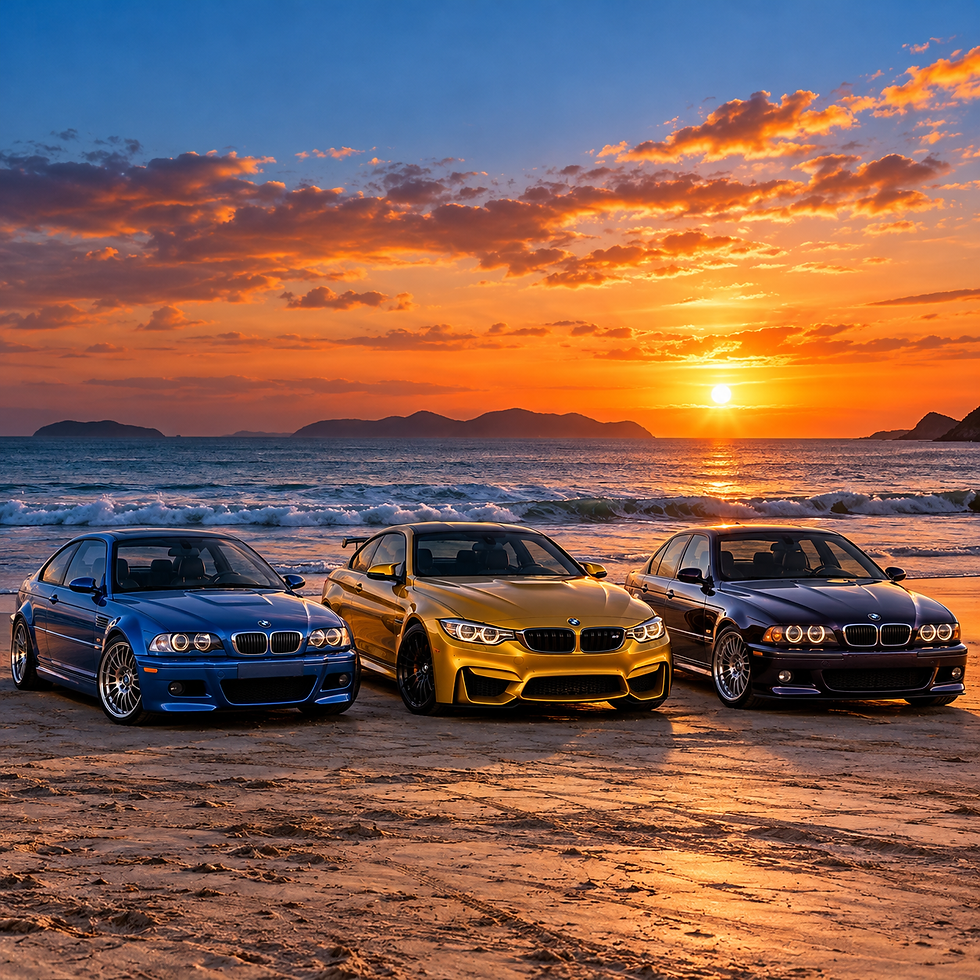
The BMW M3 E46, BMW M4 F82 and BMW M5 E39 represent three very different interpretations of the same idea: take a BMW, give it a serious dose of motorsport engineering, and create something that feels special every time the engine fires.
They were born in different eras, with different engines, different technology and very different personalities. Yet put the three together and something becomes obvious: none of them needs to be the newest BMW to be extraordinary.
In fact, that's exactly why these three remain so fascinating.
The three generations at a glance
BMW M3 E46 | BMW M4 F82 | BMW M5 E39 | |
Engine | S54B32 | S55B30 | S62B50 |
Configuration | 3.2L naturally aspirated I6 | 3.0L twin-turbo I6 | 4.9L naturally aspirated V8 |
Power | 343 hp | 431 hp | 400 hp |
Torque | 365 Nm | 550 Nm | 500 Nm |
0–100 km/h | ~5.2 s* | 4.1 s DCT | 5.3 s |
Top speed | 250 km/h | 250 km/h** | 250 km/h |
Transmission | 6-speed manual / SMG | 6-speed manual / 7-speed DCT | 6-speed manual |
Character | High-revving analogue sports car | Brutally fast modern coupé | V8 super-sedan |
BMW's quoted figure for the M3 Coupé.* 250 km/h electronically limited; higher limits were available with the appropriate M Driver's Package.
BMW's own historical material gives the E46 M3 343 hp and 250 km/h, while BMW M describes its S54 as producing 365 Nm and taking the Coupé to 100 km/h in 5.2 seconds.
The E39 M5 produced 400 hp and 500 Nm, reached 100 km/h in 5.3 seconds and was electronically limited to 250 km/h.
The F82 M4 took another enormous step forward: 431 hp, 550 Nm and 0–100 km/h in 4.1 seconds with the seven-speed M DCT.
But the numbers only tell part of the story.
BMW M3 E46: The one you drive with your ears
If you wanted to explain to somebody why enthusiasts become emotionally attached to cars, the E46 M3 would be an excellent place to start.
Its 3.2-litre S54 straight-six is one of the great naturally aspirated BMW engines.
There is no turbocharger waiting to build boost. No huge wave of torque arriving at low rpm. No complicated electronic intervention trying to disguise the physics.
Instead, the engine wants to rev.
Maximum power arrives at 7,900 rpm, and BMW quotes 343 hp from the 3.2-litre six-cylinder. That works out to an impressive 106 hp per litre for its era.
And that changes the way you drive it.
The M3 E46 rewards you for keeping the engine alive, working through the gears and allowing the S54 to climb toward its upper reaches. The soundtrack changes as the revs rise, and the sensation is remarkably different from a modern turbocharged M car.
It feels mechanical.
It feels alive.
And that is a huge part of the E46's appeal.
It wasn't just about the engine
BMW didn't simply drop a powerful six-cylinder into a 3 Series and call it an M3.
The E46 received a specifically developed chassis, widened bodywork, M suspension and a variable M differential lock. BMW says the differential was fundamental to getting the engine's power onto the road.
BMW Group Classic also points out that the E46's combination of relatively low weight, its emotional straight-six and sporting design is a major part of why the car remains so popular today.
And then there was the M3 CSL.
The CSL took the basic E46 formula and turned everything up another notch: 360 hp, a claimed 1,460 kg kerb weight in BMW Group Classic's specification, 0–100 km/h in 4.9 seconds and a production run of only 1,383 cars.
That car is now a legend in its own right.
But even the standard E46 M3 possesses something the CSL cannot manufacture:
the feeling of being exactly the right car at exactly the right time.
BMW produced 54,750 E46 M3 Coupés, making it one of M GmbH's most successful models.
Today, clean examples are increasingly treated as enthusiast cars rather than simply old used BMWs.
And that distinction matters.
BMW M5 E39: The gentleman's supercar
Then there is the M5 E39.
If the E46 M3 is the athlete, the E39 M5 is the gentleman who happens to have a heavyweight boxer living under his right foot.
The formula was almost absurdly good.
A discreet four-door BMW sedan.
Four exhaust pipes.
A six-speed manual gearbox.
And beneath the bonnet, a 4.9-litre naturally aspirated V8 producing 400 hp and 500 Nm.
BMW called it the most powerful M model in its range when it arrived.
This was the car that proved you didn't need a two-seat exotic sports car to have serious performance.
You could take four people to dinner.
Put luggage in the trunk.
Drive hundreds of kilometres on the motorway.
And then find an empty piece of road and discover that the car was capable of things that a sensible family sedan simply shouldn't be able to do.
The S62 V8 used individual electronic throttle control and double VANOS. BMW says the engine delivered its 500 Nm maximum torque from 3,800 rpm, helping the M5 reach 100 km/h in just 5.3 seconds.
And then came the famous 250 km/h electronic limit.
The remarkable thing is that 5.3 seconds to 100 km/h doesn't sound outrageous today.
But that's exactly the trap.
Numbers have moved on.
The experience hasn't.
The E39 M5's combination of V8 response, rear-wheel drive, manual transmission and understated styling creates something that modern performance cars struggle to reproduce.
It doesn't shout:
"Look at me."
It quietly suggests:
"You really don't know what you're dealing with."
BMW produced just 20,482 E39 M5s worldwide between 1997/1998 and 2003, depending on the production-date convention used in BMW's archives.
And unlike the E46 M3, the M5 E39 was produced exclusively as a sedan. BMW even built a Touring prototype, but it remained a one-off.
That makes the E39 even more interesting today.
It's the ultimate understatement machine.
BMW M4 F82: When M went turbo
Then BMW changed the rules.
In 2014 came the M4 F82, and for the first time the M3/M4 generation moved into turbocharged territory.
The engine was the S55B30, a 3.0-litre twin-turbocharged inline-six.
And the numbers immediately changed the game:
431 hp.
550 Nm.
7,600 rpm maximum engine speed.
And with the seven-speed M DCT, 0–100 km/h in 4.1 seconds.
This wasn't simply an M3 with a new badge.
BMW separated the coupé and convertible from the M3 name, creating the M4 designation for the two-door cars.
The result was a car that felt considerably more violent than its predecessors when you opened the throttle.
And that 550 Nm is the key.
The E46 asks you to chase the power.
The M4 brings the power to you.
Its maximum torque arrives from around 1,850 rpm, meaning that the F82 can explode forward without needing to be wound up anywhere near the redline.
That makes the M4 devastatingly effective in real-world acceleration.
BMW also used extensive lightweight construction. The original F82 M4 had a DIN weight of approximately 1,497 kg, around 80 kg lighter than its predecessor.
And then BMW started turning the dial.
The M4 didn't stay at 431 hp
In 2016, BMW introduced the Competition version.
Power rose from 431 to 450 hp, while the suspension and exhaust calibration were also revised.
Then came the remarkable M4 CS.
Now we're talking about 460 hp, 600 Nm and 0–100 km/h in 3.9 seconds.
BMW's official Nürburgring Nordschleife time for the F82 M4 CS was 7:38.
Suddenly, the M4 wasn't merely a fast road car.
It was getting dangerously close to serious track machinery.
And that evolution says something important about the F82.
It was the bridge between the old BMW M philosophy and the modern one.
It still had rear-wheel drive.
It could still be ordered with a manual gearbox.
It still had a relatively compact six-cylinder engine.
But turbocharging gave it a level of torque and acceleration that the E46 could never reproduce.
So which one is actually faster?
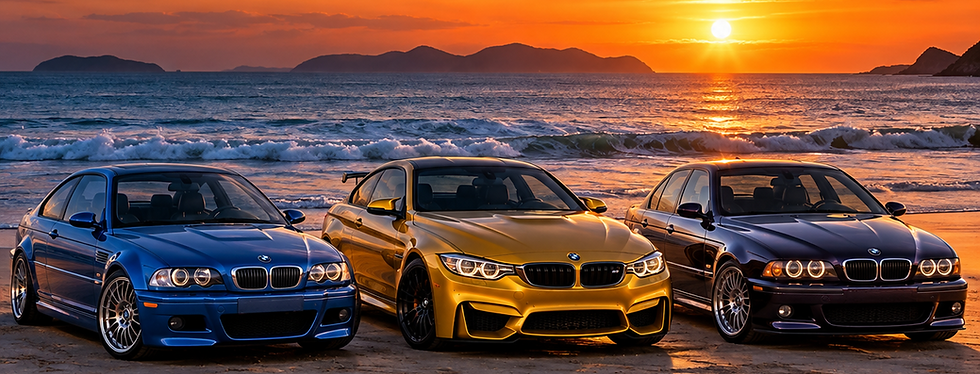
On paper, this isn't much of a contest.
0–100 km/h
M4 F82 DCT — 4.1 seconds
M3 E46 — approximately 5.2 seconds
M5 E39 — 5.3 seconds
The M4 wins.
And it wins convincingly.
But here's where comparing these three cars becomes much more interesting.
The E46 and E39 were engineered in a world where 5 seconds to 100 km/h was serious supercar territory.
The F82 arrived more than a decade later in a world where electronic engine management, turbocharging, dual-clutch transmissions and vastly improved tyres had transformed what was possible.
So the M4's advantage isn't simply horsepower.
It's technology multiplying horsepower.
And what about top speed?
All three were electronically limited to around 250 km/h in their standard configurations. BMW lists 250 km/h for the E46 M3 and E39 M5.
The F82 M4 was also normally limited to 250 km/h.
But with the appropriate M Driver's Package, the M4 could go considerably further.
BMW's Brazilian launch material for the 2018/19 M4 stated a maximum of 305 km/h with the M Driver's Package.
That's a remarkable number when you remember that we're talking about a car that still has four seats, a proper boot and can be driven every day.
Three engines. Three personalities.
And this is where the comparison becomes more interesting than a spreadsheet.
The S54: the musician
The M3 E46's S54 is about revving, sound and response.
You work for the performance.
You hear the engine building.
You feel the car becoming more alive as the revs climb.
It is probably the most rewarding of the three if what you want is an intimate connection between driver, engine and road.
The S62: the brute
The M5 E39's S62 is different.
It doesn't need to scream to make its point.
It's a V8 with almost five litres of displacement and 500 Nm of torque.
Press the accelerator and the car simply moves.
The genius is that BMW managed to combine that engine with a relatively understated sedan and a six-speed manual gearbox. BMW itself describes the E39 M5 as combining high dynamic ability with comfort and everyday usability.
It might be the ultimate expression of the old-school BMW M philosophy:
A serious sports car disguised as a businessman's sedan.
The S55: the weapon
The F82's S55 is the most brutally effective engine here.
Twin turbos.
550 Nm.
431 hp.
7,600 rpm.
And the ability to deliver its torque from only around 1,850 rpm.
The M4 doesn't wait for you.
It attacks.
And when connected to the seven-speed DCT, the acceleration becomes almost clinical.
The M4 is the car here that most clearly demonstrates how far BMW M engineering had evolved.
But which one has the most soul?
Now we leave the specification sheet.
And this is where things become subjective.
The M4 F82 is the fastest.
The M5 E39 has the greatest engine displacement and one of the most charismatic V8s BMW ever installed in an M car.
But the M3 E46 may be the purest driver's car of the three.
Why?
Because it sits almost perfectly between old and new.
Modern enough to be genuinely usable.
Old enough to still feel mechanical.
Powerful enough to be exciting without being overwhelming.
And small enough that you can actually exploit a significant portion of its performance on the road.
That's a very difficult combination to reproduce.
The real value of these BMWs isn't measured in horsepower
This is perhaps the most important point.
You can buy newer BMWs that are faster than all three.
You can buy modern M cars with considerably more than 500 hp.
You can buy cars that accelerate to 100 km/h in three seconds.
You can buy electric cars that make the acceleration figures of the E46 and E39 look almost comical.
But that's not why people still talk about these cars.
The E46 M3 represents the high point of the naturally aspirated straight-six M3 formula.
The E39 M5 represents one of the greatest combinations of V8 power, manual transmission, rear-wheel drive and everyday usability ever put into a sedan.
And the F82 M4 represents the moment BMW M successfully dragged that philosophy into the turbocharged era without completely losing the driver's connection to the car.
That's their real worth.
Three M cars. Three reasons to fall in love.
The E46 tells you to rev it.
The E39 tells you to listen to it.
The F82 tells you to hold on.
And that's why putting these three cars together is so much more interesting than simply asking which one is fastest.
Because they represent three different moments in BMW M history.
One is analogue.
One is muscular.
One is technological.
And all three are unmistakably BMW M.
The numbers may change.
The regulations may change.
The engines may change.
But when you see an E46 M3, an E39 M5 or an F82 M4 sitting still, you already know what they are capable of.
And when the engine starts?
That's when the argument really begins.
The numbers that matter

BMW M3 E46
3.2L S54 naturally aspirated inline-six
343 hp @ 7,900 rpm
365 Nm
~5.2 sec 0–100 km/h
250 km/h electronically limited
54,750 Coupés produced
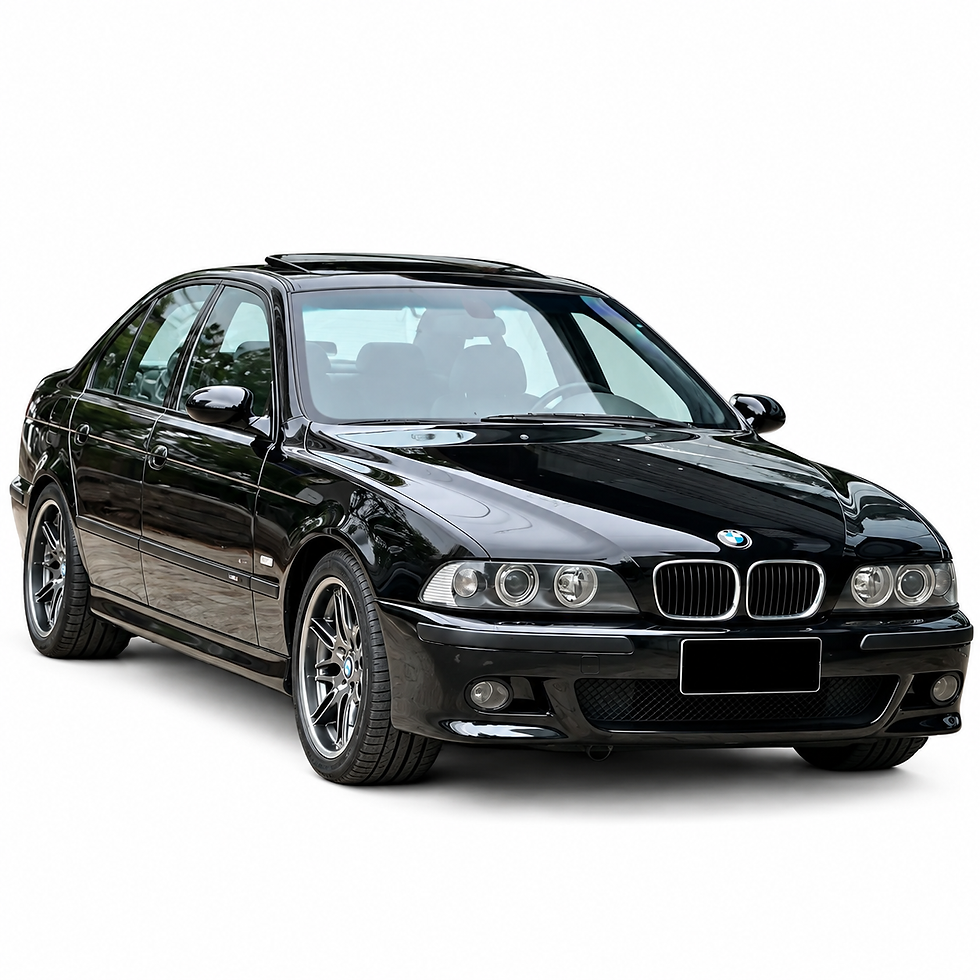
BMW M5 E39
4.9L S62 naturally aspirated V8
400 hp @ 6,600 rpm
500 Nm
5.3 sec 0–100 km/h
250 km/h electronically limited
20,482 produced

BMW M4 F82
3.0L S55 twin-turbo inline-six
431 hp
550 Nm
4.1 sec 0–100 km/h with M DCT
250 km/h standard
up to 305 km/h with M Driver's Package in the Brazilian-market specification
And that's the beauty of it:
You don't have to choose the newest.
You just have to choose the one that makes you want to turn the key — or press the starter — one more time.
Take care!
Prof. Carl Boniface
BMW Enthusiast Peças BMW Aldor Import


Comentários