Beauty & The Beast


There are cars that are beautiful. There are cars that are fast. There are cars that are luxurious, sophisticated, practical or technologically impressive.
And then there are BMWs.
Because a BMW has always had something slightly different about it. It can be elegant without looking soft. Aggressive without looking vulgar. Luxurious without becoming excessive. And, somehow, it can make a parked car look as though it is already moving.
That is the idea behind Beauty & The Beast: the beauty of BMW design and the beast that lives underneath it.
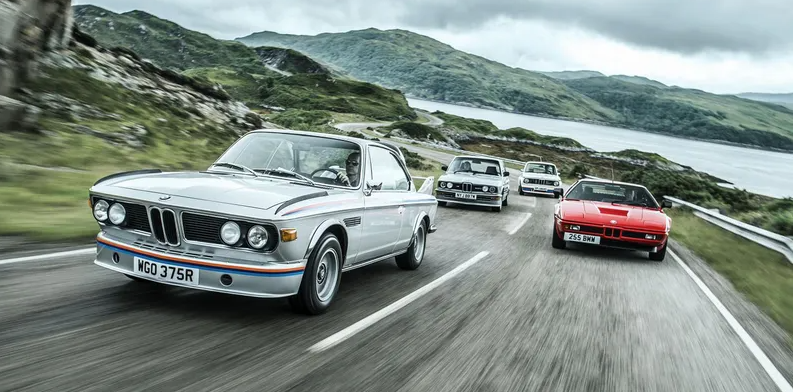
Look at the photograph above. At first glance, it is simply a group of beautiful classic BMWs travelling through the mountains. But look again at the silver car leading the pack. That is not just an old BMW. It is a BMW 3.0 CSL, one of the cars that helped create the legend behind BMW Motorsport.
The 3.0 CSL was the lightweight, motorsport-focused evolution of the E9 coupé. The final 1973 version used a 3.153-litre straight-six producing 206 hp and 292 Nm, with a top speed of around 220 km/h. Only 167 examples of this final version were produced. Its dramatic aerodynamic package earned it the nickname “Batmobile” — and honestly, it is difficult to think of a more appropriate name.
It is beautiful, but it is also unmistakably a beast.
And BMW did not need enormous wings, enormous wheels or aggressive electronic graphics to communicate that. The long bonnet, the low roof, the Hofmeister kink, the kidney grille and those four round headlights were enough. The car looks elegant standing still, but every line suggests that it would rather be attacking a corner.
Then there is the little white car behind it: the legendary BMW 2002 Turbo.

This is where BMW's idea of “beauty and beast” becomes even more interesting. The 2002 Turbo looked compact and almost innocent by today's standards. But beneath that relatively simple body was a 2.0-litre turbocharged four-cylinder producing 170 hp and 240 Nm. In 1973, that was serious performance. BMW quoted 0–100 km/h in around seven seconds and a top speed of 211 km/h.
More importantly, the 2002 Turbo was a technological statement. It was the first European production car fitted with an exhaust-gas turbocharger, laying down a philosophy that would influence generations of BMW performance engines.
And that is perhaps what makes these cars so special.
The beast was never separate from the beauty. The beauty was designed around the beast.

BMW has always understood that performance is not only about horsepower. It is about the way the car responds when you turn the steering wheel. The way the chassis settles into a corner. The way the accelerator responds to your foot. The way the engine builds power. The way the transmission changes gear. The way the driver's seat seems to hold you exactly where you need to be.
That last part is particularly difficult to explain to someone who only compares cars by specifications.
A BMW often feels as though it was designed around the driver rather than simply designed to carry one.
You sit down and the relationship begins. The controls fall naturally to hand. The driving position feels deliberate. The steering wheel feels like an invitation. The bonnet seems to stretch forward exactly where you want it to go. And when the road begins to twist, the car suddenly feels smaller, more agile and more connected than it did five minutes earlier.
That is the magic.
Modern BMWs may have eight-speed automatic transmissions that change gears so smoothly you barely notice them, turbocharged engines that deliver enormous torque from relatively small displacement, adaptive suspension, sophisticated electronics and more computing power than the engineers of these classic cars could have imagined.
But the fundamental idea remains remarkably familiar.
The car should respond to the driver.

That is why nostalgia is such a powerful part of BMW ownership. It is not simply nostalgia for an old car. It is nostalgia for an era when cars had personalities.
The 2002 Turbo had its turbocharger, its compact proportions and its unmistakable Motorsport colours. The 3.0 CSL had its lightweight construction, its straight-six and its outrageous aerodynamic treatment. They were technically sophisticated for their time, but they were also visually unmistakable.
You knew what they were before you even heard the engine.
That is something modern cars sometimes struggle to achieve.
Today, two cars from completely different manufacturers can have similar screens, similar digital dashboards, similar driver-assistance systems and similar performance figures.
Technology has made cars better in countless ways, but it has also made them more alike.
BMW's strongest identity has always been somewhere else.
It is in the proportions. The stance. The driver-focused cockpit. The balance. The engine character. The sound. The way the car moves through a corner. And, perhaps most importantly, the feeling that you are driving something with a personality of its own.
This is why a BMW can become more than transportation.
For some people, a car is simply something that takes them from A to B. There is absolutely nothing wrong with that.
But for an enthusiast, the journey is part of the destination.
You remember the first BMW you drove. You remember the sound of the engine. You remember the feeling of accelerating onto an empty road. You remember the way the car felt on a fast corner. You remember the smell of the interior, the shape of the steering wheel, the way the dashboard looked at night.
Years later, those details remain.
That is the strange power of a great automobile: it creates memories that have nothing to do with transportation.
And this is where BMW occupies a very particular place in the automotive world.
It is not perfect. BMWs can be complex. They can be expensive to maintain. Modern cars contain sophisticated cooling systems, turbochargers, electronics, suspension components, transmissions and engine-management systems that demand proper maintenance.
But perhaps that is also part of the bargain.
You do not buy a BMW only for the badge.
You buy the engineering underneath it. You buy the way it drives. You buy the design. You buy the history. You buy the feeling when you open the garage door and see it sitting there.
And yes, you buy a little bit of the beast.
Because beauty alone is not enough.
A beautiful car that does not make you want to drive it is simply an object.
A BMW has always aimed for something more dangerous than that.
It wants you to get in.
It wants you to start the engine.
It wants you to find an empty stretch of road.
And it wants you to take the long way home.
That is Beauty & The Beast.
And perhaps that is why, decades after the 2002 Turbo and 3.0 CSL first appeared, people are still looking at these cars — and still dreaming about owning one.
Because some cars age.
BMW legends don't.
Take care! Prof. Carl Boniface
BMW Enthusiast


Comentários